

CoffeeEmbassy
Beyond Blend
Beyond Blend
Couldn't load pickup availability
We are excited to introduce an update to Beyond Blend. This iteration brings together three Colombian varieties; Tabi, Typica and Sidra, connecting two farms through their commitment to experimentation and coffee quality.
This release explores the work that happens before coffee reaches the roastery. From fermentation with coffee cherry extracts to resting dried parchment in former beer barrels, each component follows a carefully managed processing method. Together, they offer a way to experience the creativity, knowledge and care behind these coffees in one blend.
Flavour Profile - Tropical Fruits, Juicy, Maple Syrup
What is Beyond?
Beyond is about exploring what the future of espresso blends could look like. To us, “Beyond” represents the possibility of something greater than what we know today, celebrating the countless flavours that coffee origins have to offer.
This iteration is a rare opportunity to do just that. It brings together three Colombian coffees from two farms in Huila: Anibal Plazas’ Tabi Calma and washed Typica from Los Nogales, alongside Nestor Lasso’s natural Sidra from El Diviso. Connected by a commitment to experimentation and coffee quality, these wonderful coffees are presented in an interesting, fruit-forward espresso blend.
Read on for more information on the origins and further reading on some of the coffee terms we use. If you would like to know more about the coffees we are always happy to chat!
Coffee terms/language
What is a Spot Seasonal Blend?
A Spot Seasonal Blend is to offer an exciting and complex coffee that is linked up with the coffee harvest season. This allows us to bring you a coffee that is always fresh and flavour driven.
Cup/Quality Score
Scoring coffee is used to define the quality of the coffee. Scores are given to the individual origins. To be considered “Specialty” a coffee must score a minimum of 80/100. Most Specialty coffees score between 80 – 87. Only a few outstanding coffees will score higher than this.
Roast Degree/Type/colour/style
Back in the days of old, coffee roasts were (and still are by some) only described as being light, medium and dark. These descriptions are still relevant to a point but coffee is no longer as straight forward. These days ones interpretation of colour can vary from roaster to roaster. We try to triangulate roast degree (Temperature) Colour and Development of the roast not just the colour (as different origins can colour differently)
Styles: Spot Seasonal Blend, Seasonal Blend, Modern Blend, Regional Blend, Single Origin.
Now we can get stuck into the coffees themselves!
The Coffees
|
Coffee |
Producer / coffee lead |
Farm |
Region |
Altitude |
Process |
|
Tabi Calma |
Anibal Plazas |
Los Nogales |
Pitalito, Huila |
1,870–2,000 masl |
Washed; thermal shock, 90-hour fermentation and resting in former beer barrels |
|
Typica 056CH |
Anibal Plazas |
Los Nogales |
Pitalito, Huila |
1,870–2,000 masl |
Washed; thermal shock and 120-hour fermentation |
|
Sidra |
Nestor Lasso |
El Diviso |
Bruselas, Huila |
1,750 masl |
Natural; staged fermentation and controlled drying |
Los Nogales — Anibal Plazas
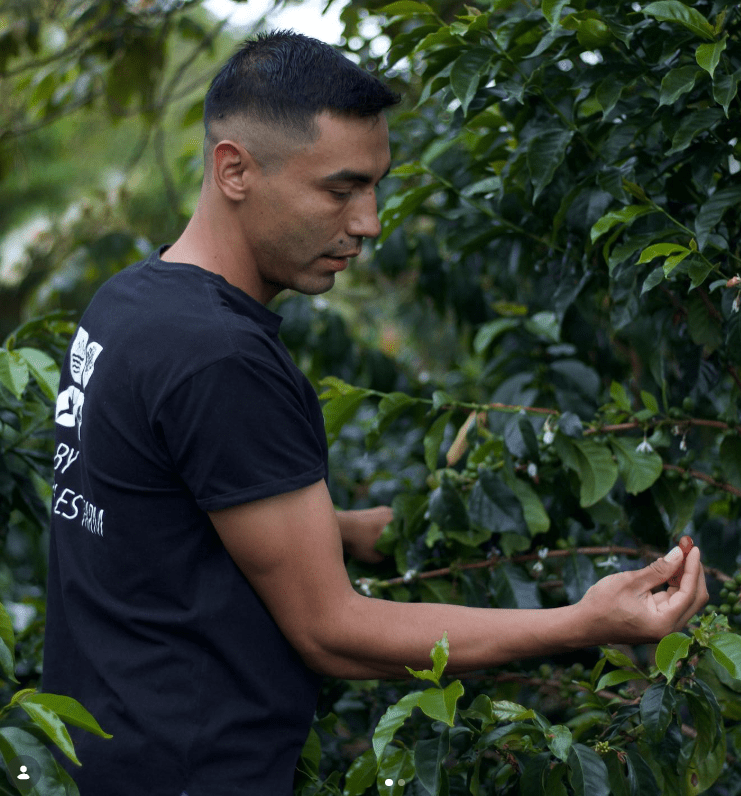
Located in the village of El Diamante, near Bruselas in Pitalito, Los Nogales carries the coffee-growing history of five generations of the Hernández family. The farm combines this background with ongoing research into growing, fermentation and drying methods.
Anibal Díaz Plazas plays a central role in evaluating coffee quality at Los Nogales. Working alongside Oscar Hernández, he assesses the results of fermentation trials and helps the team understand how changes in processing translate into the cup.
Care begins well before processing. Pickers are trained to select ripe cherries, which are transported in baskets to protect the fruit on its way to the mill. The farm also uses organic matter to make fertilisers, with an emphasis on supporting the soil and coffee plants.
Two coffees from this work feature in the blend.
Tabi Calma — Washed
Ripe cherries are cleaned and sorted by density before undergoing a thermal-shock treatment: 20 seconds in water at 80°C, followed by three minutes in water at 15°C.
The cherries are then pulped, and extracts obtained by pressing the coffee cherry skins are added alongside a fermentation starter. The coffee ferments for 90 hours before sun-drying for approximately 15 days.
Once dried, the coffee is placed, still in its protective parchment layer, into barrels previously used for beer. This additional resting stage is a distinctive part of the Calma process.
Typica 056CH — Washed
The Typica begins with similarly careful picking, cleaning and density sorting. Selected cherries receive a thermal-shock treatment using water at 80°C for 20 seconds, followed by rapid cooling in cold water.
After pulping, coffee cherry extracts and fermentation starters are introduced. This lot undergoes a longer, 120-hour fermentation before approximately 15 days of sun-drying.
Although both Los Nogales coffees are described as washed, their processing involves several additional steps that distinguish them from a conventional washed method.
El Diviso — Nestor Lasso
Near Bruselas in Huila, Nestor Lasso and his brother Adrian have developed their family’s work in coffee through experimentation and a focus on specialty production. Their collaboration with fellow producer Jhoan Vergara and the team at CATA Export has supported the development and refinement of their processing methods.
Sensory evaluation is an essential part of that work: tasting the coffees helps the team understand whether each change in processing improves the final result.
Sidra — Natural
Hand-picked ripe cherries pass through alternating stages of fermentation with and without exposure to air. These include an initial 12-hour oxidation stage, 50 hours of anaerobic fermentation, a further 20-hour oxidation stage and a second anaerobic stage lasting 30 hours.
The cherries then undergo an 18-hour submerged fermentation using warm water and coffee must—the juice or extract collected during an earlier harvest’s oxidation process.
Drying takes place in covered drying structures known as marquesinas. At approximately 18% moisture, the cherries are rested in bags in a dark room for 60 hours, then returned to the drying structures until they reach approximately 11% moisture.
Recipe
This is a good starting point for all of our espresso coffees. Adjust Accordingly to your own preference
Ground Coffee: 20g Espresso
Weight out: 25g
Contact Time: 25-30 Seconds
Recommended Brewing Age
10+ days after roast date
Subscriptions
For more info on subscriptions, head to the Subscriptions page.
Share