

CoffeeEmbassy
Oscar Hernández | Washed Caturra, Low-Caf
Oscar Hernández | Washed Caturra, Low-Caf
Couldn't load pickup availability
Oscar Hernández Washed Caturra, Low-Caf
This next release challenges the assumptions we bring to coffee and what we might discover when we set them aside.
We first tasted this washed Caturra in a blind cupping of 26 coffees. Without knowing what any of them were, we relied entirely on what was in the cup. It stood out as the clear favourite, both for us and for everyone else attending. From the first sip, we knew we wanted it. Discovering afterwards that it had undergone a natural decaffeination process only made us want it more.
What we love about this coffee is that it’s an exceptional cup, particularly suited to soft brewing, that also challenges the misinformed idea that reducing caffeine means compromising on quality. Tasted alongside the other coffees on the table, nothing about it suggests a compromise.
Grown and processed by Oscar Hernández, this washed Caturra is decaffeinated at the farm level. After processing, the green beans undergo a soaking method using a natural solvent derived from coffee pulp or husk to draw out most of the caffeine, whilst retaining the coffee’s vibrant fruit character and natural sweetness.
It showcases Oscar’s skill, experience and understanding of coffee growing and fermentation. We’re excited to share it as a single-origin filter release: a low-caffeine coffee that opens up the possibility of enjoying an exceptional cup later in the day, long after we’d usually stop drinking coffee.
This release is an invitation to reconsider what decaf can be, letting the cup tell its story first.
Producer – Oscar Hernández
Location – Pitalito, Huila, Colombia
Farm – Los Nogales
Variety – Caturra
Years Used – 1st year
Altitude – 1,870-2,000 MASL
Process – Washed and naturally decaffeinated
Cupping Notes – Yellow Fruits, Grape, Pineapple
Roast Level – Light
Suitable For – All Filter Brew Methods
Exporter & Importer – CATA Export
Download a Digital Tasting Card
Disclaimer: Cupping notes are a guide based on what we tasted whilst cupping this coffee. Your experience may differ depending on brewing method.
About
Los Nogales is located in Pitalito in Colombia's Huila region, at 1,870-2,000 metres above sea level. The farm is led by Oscar Fernando Hernández, who grew up in the Laboyos Valley and studied environmental management before serving in the Colombian Navy. After his father's passing, Oscar returned to Los Nogales and began transforming it into a centre for coffee innovation.
Los Nogales forms part of a three-farm project alongside Finca Nahui and Finca Neblina. Drawing on lessons from Panama, the team has introduced advanced drying techniques with precise control of temperature and humidity. Their work brings together terroir, genetics and science, supported by a balanced fertilisation programme using microorganisms and minerals to improve soil health and cup quality.
Oscar's goal is to improve production, create dignified employment and promote responsible practices, while establishing Los Nogales as a benchmark for coffee innovation in Colombia.
The variety
Caturra is a natural mutation of Bourbon first identified in Brazil. Its compact growth makes it easier to plant and manage than taller traditional varieties, while its cup quality can be excellent when it is grown at high altitude and carefully processed.
At Los Nogales, Caturra is cultivated between 1,870 and 2,000 metres above sea level. The cooler conditions at this elevation support slower cherry development and help build the sweetness, clarity and lively citrus character found in this coffee.
The Processing Method
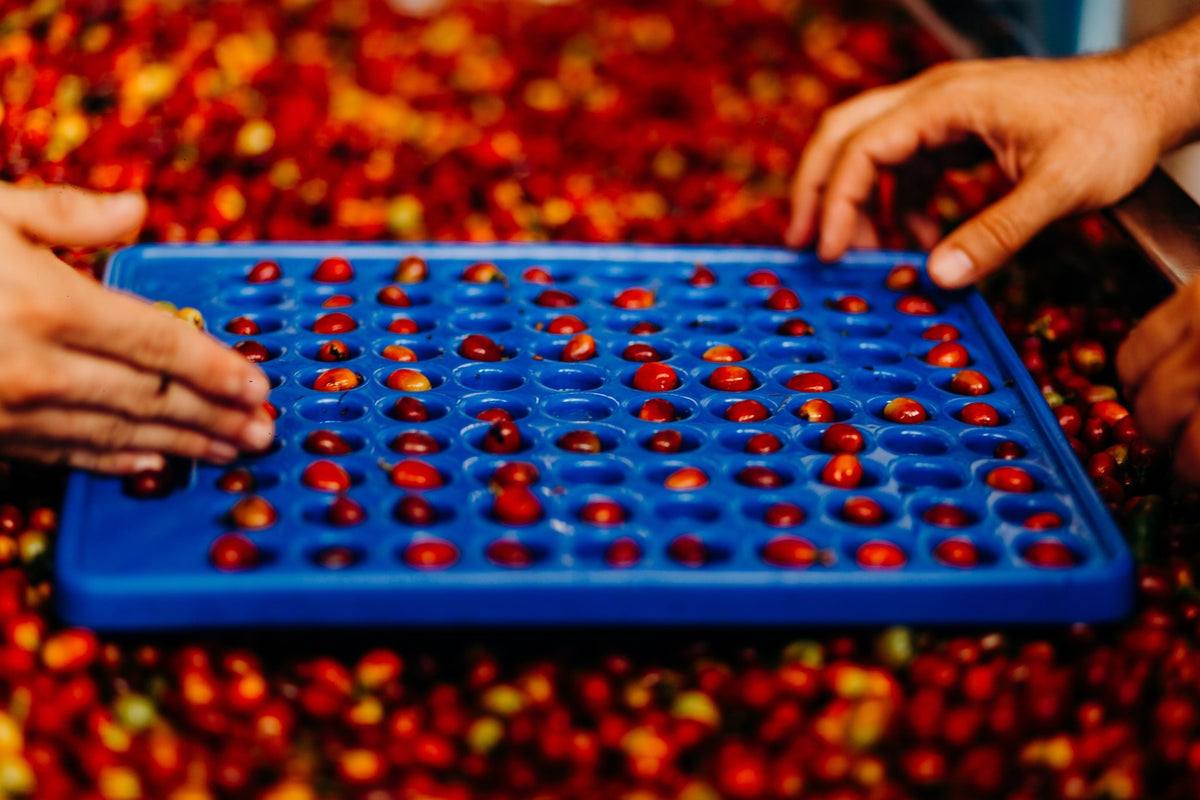
The coffee is selectively hand-picked at full ripeness before the cherries are floated in water to remove defective or underripe fruit. The selected cherries undergo a 24-hour fermentation, after which the coffee is washed and sun-dried on raised beds to its target moisture level. Once dry, the coffee is hulled to prepare it for decaffeination.
The decaffeination stage begins by immersing the green coffee in water at 40 C for four hours at a 2:1 water-to-coffee ratio. This immersion is completed twice. A natural solvent derived from coffee pulp or husk is then introduced, and the coffee rests for a further 24 hours. Finally, the beans are thoroughly washed and dried for approximately five days until stable.
This carefully controlled process removes caffeine while preserving the coffee's clean sweetness, vibrant citric acidity and delicate herbal character.
Decaffeination
There are a few different ways to decaffeinate specialty coffee, and we've worked with coffees processed using both Swiss Water and EA methods. Each takes a different approach to removing caffeine while retaining as much of the coffee's original character as possible. But what makes this one particularly interesting is in both the quality of the coffee itself, and where the decaffeination happens.
Rather than being sent to a dedicated decaffeination facility, this coffee is decaffeinated at the farm by Oscar Hernández and the team at Finca Los Nogales.The coffee is grown, harvested and processed using the washed method before the green beans undergo decaffeination on the farm, using a natural solvent derived from coffee pulp or husk.
|
Method |
How it works |
|
Swiss Water |
Swiss Water's dedicated facility is in Vancouver, Canada, which is where all green coffee decaffeinated in this way is sent to. There, coffee is soaked in a solution made from water and coffee extract. Caffeine moves out of the beans into the solution, which is then filtered to remove the caffeine and reused. |
|
EA / Sugarcane |
Green coffee is treated with ethyl acetate, a naturally occurring compound commonly produced from fermented sugarcane. The solvent bonds with the caffeine and draws it from the beans. In Colombia, this is commonly done at dedicated facilities. |
|
Coffee pulp / husk |
After the coffee has been processed and dried, the green beans are soaked in water before a natural solvent derived from coffee pulp or husk is introduced. The solvent draws out the caffeine before the beans are washed and dried. In this case, the process takes place at the farm itself. |
Filter Recipe
This is a good starting point for all of our Filter coffees. Adjust Accordingly to your own preference.
Ground Coffee: 20g
Brewed Weight: 300g
Contact Time: 3-3:30 mins
Water
Your brewing water can make or break whether a coffee tastes vibrant and expressive or flat and muted. Since local water supplies vary, we’ve partnered with Apax Lab to help optimise your home brewing water.
The following recipes are designed as starting points, focusing on clarity and even extraction to let the coffee’s natural acidity and sweetness shine.
For the Low-Key Approach
Base Water: Christchurch tap water
-
Hardness (GH): 45ppm
-
Alkalinity (KH): 52ppm
Apax Drops per 1L:
-
Tonik: 10 drops
-
Jamm: 5 drops
Since the alkalinity is already relatively high, Lilac is not needed, as alkalinity naturally buffers acidity. Instead, we focus on Tonik to increase hardness for improved extraction and Jamm to enhance texture, helping round out the cup.
Adjusting for Local Water Conditions
Christchurch's water supply is sourced from multiple groundwater wells across the city. While the overall water profile is relatively consistent, natural variation exists between supply zones. As a practical rule of thumb, the PPM may vary by approximately 5–15 ppm depending on location.
For this reason, the recommended APAX recipe should be viewed as a starting point rather than a fixed target. The strength of the APAX system lies in its flexibility; mineral ratios can be adjusted easily to suit local water conditions and taste preferences.
If coffees taste flat or lack vibrancy, increasing Tonik may improve extraction, flavour clarity, and acidity. If coffees taste overly sharp or acidic, increasing Jamm may help improve balance and perceived sweetness. Adjustments should be made incrementally and evaluated through taste.
For the Coffee Geek
Base Water: Fully distilled water (<1ppm TDS)
Apax Drops per 1L:
-
Tonik: 30 drops
-
Jamm: 5 drops
-
Lilac: 10 drops
This recipe provides a balanced foundation that can be adjusted further depending on your taste preferences and the coffee being brewed.
If you are outside of Christchurch, we recommend using the distilled water recipe.
Always add to the water before brewing - not the brewed coffee.
If you need assistance or are simply curious about the Apax drops, our Head of Coffee, James, welcomes all enquiries. You can get in touch at james@coffeeembassy.co.nz.
Recommended Brewing Age
14+ days after roast date
Share